Tiger killer
Episode 1: Hello there
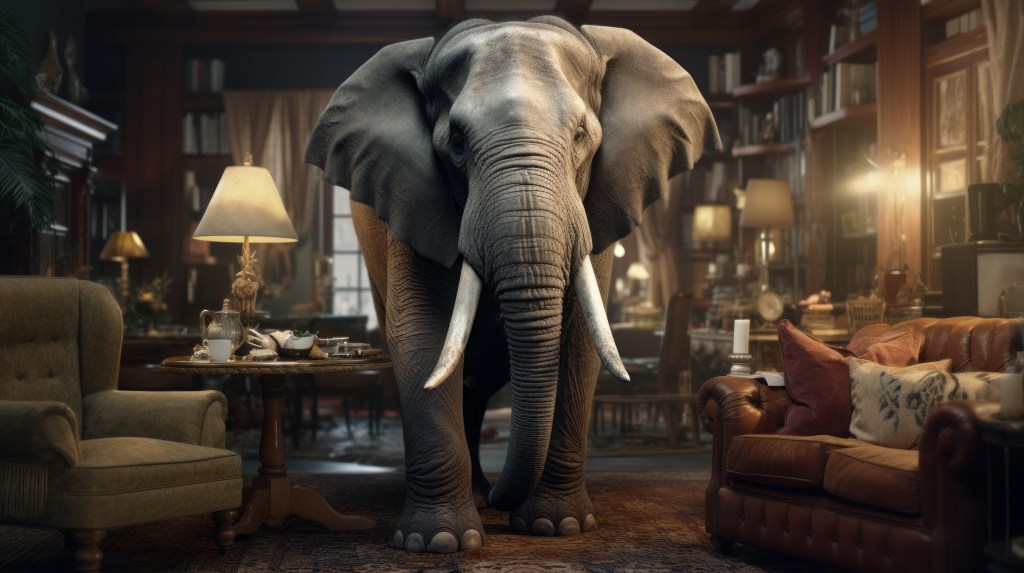
The elephant is there when I open the door. You should know that I have a large office in the Ritter Building, a converted Edwardian mansion that was the summer home of Mrs. Ritter when she fled north from the city to escape the heat.
I met her once, Mrs. Ritter, at a ceremony where she stood skinny and smiling, pointing to a plaque about her dead husband for reporters when she gave the building to the university. She was rich and pretty and not much older than me. The Ritters made their fortune slaughtering horses for dog food.
The husband had died a few years before under what some say were suspicious circumstances. Someone said that his body was misplaced on the way to the hospital in a company truck. How do you misplace a body? It would be disrespectful to make a joke about the missing husband and dog food so I won’t.
That was thirty-eight years ago. I remember because it was my first year teaching in the English department. I was hired as sessional faculty which meant I wasn’t permanent because they weren’t giving out permanent jobs. Sessionals get one year. And every year, the university would give me another one-year contract for the next year. I have to sign a page that is a scratchy photocopy of an original that was lost years ago agreeing that I knew I wasn’t permanent. Return one copy. Keep one copy for me. Not permanent. Every year for thirty-eight years I sign that I’m not permanent. I have all thirty-eight years in a drawer.
The faculty association pushed for an end to sessionals. Better for everyone they said. So this year there are no one-year contracts, only permanent positions. But I won’t be getting one because I’m too old to be considered for a permanent job.
I’ve been here so long I can’t be permanent. I declined to be interviewed for a faculty position by administrators I’d interviewed years ago when the university hired them.
When I first came here, the building was surrounded with meadows and stands of trees, willows I think. A stream used to run through the back where they built the quad with cement tables for the undergraduate pub. In those days, the closest building was the gate-keeper’s cottage beside the lane running through the east meadow up to the central courtyard.
The sociology department has offices on the second floor. The president is on the fourth floor. A faded photograph outside his office shows a stately manor sitting strangely out of place, like the ghost of a grand hotel stuck in a cow pasture. Most of the grounds have since been built up by the university. I’m in that picture on the wall. You can’t see my face but I recognize the top of my head behind some clerks who were rounded up and squeezed together on the front steps by the photographer and told to put out their cigarettes and look like they were professors. I wanted to tell him I actually was a professor. But I didn’t.
The building has high chimneys and a rose trellis covering the façade. Four floors with three porcelain baths on each floor, all stacked directly above each other as the floors go up. I find it comforting that the bathroom is always in the same place no matter if you accidently find yourself on a different floor. It’s something you can depend on. I’m sure it wasn’t the result of a belief system but rather what was considered efficient plumbing back then. The pipes rattle when someone flushes above you.
I like the place because it has resisted change admirably.
I said my office is large. A sitting room on the main floor at the back, it has double French windows facing east. The energy efficiency people bricked up the fireplace on the west wall a few years ago. Facing my desk, the south wall is covered floor to ceiling with books except where they give way to one of the two pillars on either side of the French windows and the gilt decorations of the cornice.
The alcove is what I really like about my office. If I were prone to speaking playfully, I’d call it a cubby. It’s in the corner three feet past the fireplace and runs away from the bookshelves. Deeper than it is wide, it could accommodate a desk placed crossways.
If you were inclined to stories about sorcerers and wizards, you would think of it as a secret compartment hidden by a wall of impenetrable shape-shifting shadows because it is dark most of the time. They never installed a ceiling light. And with the sun reaching in only a few minutes each day, around nine thirty-seven to be precise, the cubby certainly does not invite you to explore what might be lurking in the foreboding depths of its architectural bowels.
If you had, for instance, a book of curses that could end life on earth as we know it and you didn’t want to be leaving it around for any fool to pick up, you’d hide it in the cubby.
I have a walking stick with a large gold knob that I don’t use because it might make me appear somewhat affected. I keep it in the back of the cubby just in case. I imagine it as a kind of poor man’s Excalibur waiting to be taken up by the one true king.
But it’s really just a cane I found in a dollar store, nothing magic or mystical about it at all. I call it Caliburn because that’s historically more accurate, being the original name for Excalibur from the Welsh before celebrities like King Wart and Walt Disney started running around with their knock-offs looking for demons and moviegoers.
The cubby’s also the perfect place to keep the files I have on all the students I’ve taught over the years.
I once tried to fit my desk in it. It afforded a degree of privacy but I decided that such an arrangement of my furniture would be construed by colleagues and students as a conspicuous disinclination to congeniality. So instead, I lined up all my file cabinets in a row, the oldest and most battered of them at the back, then the next oldest, and then the next, until the one close to a visitor who happened to glance over would appear relatively unscathed with only a few dents and scratches.
My office is a comfortable place that breathes a quiet domesticity.
So you can imagine I’m not entirely pleased to see the elephant just show up.
“Hello there.”
Episode 2: Jumbo the artificer
Fortunately it’s not a huge elephant. But he’s still larger than you usually see in an office, even one the size of mine. Six maybe seven feet tall. Seems young. He appears quite clean as elephants go, and small mercies there’s nothing on the carpet. You must understand, I’m not unduly fastidious. I wouldn’t ask you to take your shoes off at the door. But I’m in a situation I’ve not encountered before. I have to proceed carefully.
From the way he’s studying the potted palm, he must be hungry. The string securing the gnarled stalk to the south pillar is still in place. Or perhaps he’s merely looking out to the quad. The French windows are slightly ajar. He certainly couldn’t have come through the door from the hall. When I move around the door, as quietly as I can towards my desk, he looks at me.
I pick up the phone and automatically say “excuse me”.
Because none of the customary responses to my excusing the call is forthcoming—the acquiescent certainly, the deferential nod, the eyes averted to the books on the far wall—it strikes me that I’ve just done something rather ridiculous: I said “excuse me” to an elephant.
Quite disconcerting to be the object of his unabashed gaze. Perhaps more startling, the sudden realization that my ritual courtesy is no different whether I’m speaking to a student or an elephant.
I’m feeling anxious. He’s not yet made a sound. I look at the books across the room. I know them by their colours.
“Hello. Professor Arsenault please.”
The sunlight spreads itself across the floor. The palm is missing lower fronds. Why did he start at the bottom? I’d brought it to the office because the cats were chewing on it in my bedroom and throwing up. Maybe he has a hairball. I hope he isn’t going to be sick.
“Could you ask him to call Professor Ogilvy when he gets in? It’s important.” I wait. I hear the click at the other end before I hang up.
Arthur Arsenault is the funniest Chairman we’ve ever had. Cast a villain in a movie who’s a game‑show host with a side gig stalking young women and climbing through unlocked windows. That would be him.
I think of him as the axe murderer who walks among us during the day and chats up undergraduate girls—sorry, young women—at night who then mysteriously vanish. Since he’s become Chair and pushed the courses of the flashier teachers, I’ve noticed a change in the students in my classes. Particularly the women who register, start the term and after a time drop out and I never see them again. They’re just names I cross out at the end of semester with no grade. Probably nothing to do with Arsenault but I do hope they’re ok. It’s a silly thought.
Arsenault’s superpower is his ability to savage a colleague’s reputation with a terrifically well‑told lie that leaves the sycophants grinning at the carnage. Like a pack of laughing hyenas, they troll about after him snorting at whatever favour he tosses them. Stupid they are. They don’t have the wit to wonder what he says about them behind their backs.
I see him sitting in his office right now choking back a maniacal laugh. Mind you, attendance at the monthly Academic Affairs has improved considerably during his term. Nobody wants to be missed. If you skip, he has a way of letting you know that he’s thinking of you.
My elephant hasn’t taken his eyes off me. I’m thankful he doesn’t seem inclined to run about. Nothing to do but wait for Arsenault. His eyes are deep, soft brown, larger than I remembered them in elephants. Maybe that’s because he’s young. Or maybe because I’ve only ever seen them at the zoo rocking back and forth impatiently. As if they’re waiting for something that never happens.
It’s different up close. Right across the desk from me. Had I been at the last Academic Affairs? I wonder whether he’s hungry.
An article in National Geographic said that the African or the Indian is bigger. One of them has larger ears. My elephant has big ears. Like Arsenault. The Indian or maybe the African is highly intelligent and placid. Not like Arsenault.
A friend to man. That was the caption above pictures of them with boys—mahouts—sitting on top, dragging logs tied with chains through the forest. I have the disturbing recollection that the other breed—the African I think—is not good with people. A nasty brute, in fact. Prone to crushing people. People? I mean trees and crops. I can’t tell now whether mine looks African or Indian. From the way he’s taking to the palm, I hope he’s responding to a hereditary urge to herd logs.
I have papers to mark for this morning. And I’ve planned to look over my notes on Joyce Cary.
It occurs to me that I am outwardly a rather solemn, unimaginative man. The thought seems unfair, even impertinent. A thorough and judicious scholar, yes. But certainly not a man to imagine he could find himself before his morning tutorial waiting for the Chairman to call so that they could discuss the matter of an elephant.
Cary’s Gulley Jimson would not suffer from any such deficiency, if in fact that is what it is. But today my lecture will show them that Gulley really is not a very nice person, certainly wouldn’t make a good neighbour, that you can’t justify all the lying and stealing and bad manners by saying it’s part of the freedom necessary to be an artist. They tend to be too easily impressed by artist figures.
And even after I drag them through James Joyce and Portrait of the Artist, they still miss the irony of it all. They love that Stephen Dedalus is young. Obviously. It’s in the title. But they forget that he’s also a bad poet, and his mother washes his ears. She’s lucky she didn’t raise an elephant who fancied himself a writer because that would be a lot of ear washing. Jumbo the artificer. Jumbo the uncreated conscience of his race.
And Gulley Jimson? Come on, man! Gulley spends a lot more time boozing than painting.
Of course, art needs new symbols so you got to try for something fresh and exciting. Blake had a tiger. Keats had an urn. But you can’t blithely say that anything is acceptable, no matter how crazy or eccentric or unintelligible, so long as it breaks all the old rules.
What about common sympathies and common feelings articulated through common symbols that evoke the pastness of the past in the presence? T.S. Eliot understood that and I for one agree with him.
There’s something to be said for the sense of history and tradition that exists in the very best art. And I want to get myself ready to say it to my students if I can get the damned elephant out of my office.
I shouldn’t curse.
Episode 3: My elephant isn’t a horse
I definitely shouldn’t use profanity around my elephant. He doesn’t deserve that.
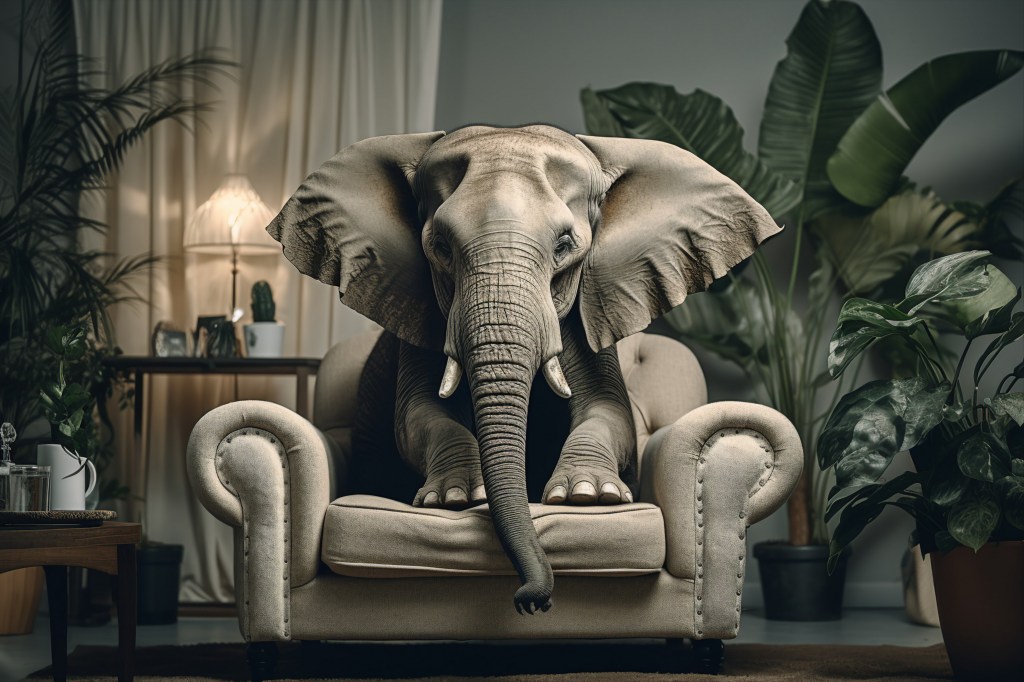
He’s remarkably calm, more than you’d expect given that it can’t be pleasant for him to be in a strange place. He’s probably hungry. Looking at me in an easy, comfortable way.
I threw away a box of sugar cubes that I used to keep in my top drawer because I’d switched to Sweet’n Low. I think of offering him two little pink envelopes from the palm of my hand, my fingers stiff and flat like when I held out apples for the milkman’s horse as a child. But why worry now about keeping my fingers flat? An elephant isn’t a horse. He’s not going to bite. He’d take whatever you offered him with his trunk.
Artificial sugar might make him irritable, and I don’t want to upset him. I sometimes feel anxious for no good reason and it’s probably a reaction to sweeteners.
Maybe a muffin? There’s still time to snag chocolate chip. I begin the day with a coffee and a muffin—usually chocolate chip—at my desk. But once the first bus of students arrives, there’s none to be had. In the wake of the juvenescent hordes who voraciously consume every last chocolate chip down to the tiniest crumb are baskets upon baskets of bran muffins. Bran that is bland, insipid, unimaginative. There’s nothing even mildly aspirational about a bran muffin to be anything other than a glorified boring cupcake.
I wonder why they don’t just make more chocolate chip. Or why make any bran at all? No one wants them. At the end of the day, the bran are left there more dry than when they started, unloved and unclaimed to be put out with the trash.
The social and political posturing inherent in the muffin calculation troubles me because it’s so obviously wrong, and yet they do it again and again. One more feature of rote liberalism, I presume. They put out the same number of chocolate chip and the same number of bran. No one dares question the egalitarian orthodoxy behind it. I’m quite happy to surrender certain personal liberties to live in a democracy. But why screw up the muffin count? The sacrifice of excellence at the sanctum sanctorum of a baked-in mediocrity. Literally.
Without fear or favour, the university’s head of muffin making would say. I suspect he perpetuates the bran because it’s unpopular and so boring it must be healthy. The baker as the progressive moralist, virtue signaling in whole wheat flour and bran. To champion the bran makes him feel important.
He’s as unencumbered by any scientific or sociological data—or even a survey of the students sprinting off the first bus racing to lay claim to all the chocolate chip—as he’s willfully blind to the most rudimentary experience of how muffins are actually eaten in the real world. That experience tells us what we all know to be true, namely that the chocolate chip muffin is inherently superior to the bran.
But still he’d affirm the egalitarian’s credo that all muffins, regardless of what they are made of, deserve equal treatment in the kitchen. I imagine him wearing a chef’s hat and holding aloft a book of bran muffin recipes as he testifies before the university’s progressive eating committee.
When we baked more chocolate chip than bran it was because that’s what people thought they wanted. They could not conceive of a breakfast menu that was different. Today, we do not believe that a muffin should be defined against some arbitrary hierarchy of presumed essential properties or inborn ingredients. We reject that some muffins are better than other muffins simply because of what they are. A muffin is a muffin is a muffin whether it be bran or chocolate or even banana. You cannot put a muffin in a box because of some baked-in bias that favours one muffin over another.
Actually muffins, especially chocolate chip, go very nicely in a box. Still, bran would probably be better for my elephant if he’s not used to the sugar rush.
I look across the quad to the cafeteria in the Student Union. I’m considering whether I can safely leave him alone when suddenly a giant umbrella bursts open, startling me with its force. He’s flapped his ears. With a snorty snuffle, he turns toward the palm. Obviously, my arrival has interrupted his snacking.
“Go ahead. You may as well finish it now that you’ve started it.”
My words sound abrupt. I’ve a reputation at my college for being taciturn. I do nothing, I assure you, to encourage it. With my visitor today, I’m merely trying to affect the amusingly arch cordiality of the jovial host. The tone, I’m afraid, has missed.
I sense his indecision. I feel I may have caused him discomfort. I take a moment to find the right phrase.
“No really, please eat as much as you like. I keep it here because it makes the cats sick—”
I stop. I should just shut up. I’m rarely at a loss for words but with my elephant I’ve become a babbling chatterbox.
I wait and then say softly, “I can’t keep it at home. Honestly, I don’t mind.”
He is, thank goodness, not easily piqued. I am held silent by his gaze before he turns back to the palm.
The trunk stretches out to explore a large, green leaf. Two wet grey fingers grasp it. The frond comes away without sending so much as a shiver through the rest of the plant.
I feel the relief of having been forgiven a grievous slight. His magnanimity is apparently proof against human perfidy for he begins to eat.
The sounds remind me of the rhythmic slapping of the wet mop of the caretaker when he washes the marble front hallway, and I’m the only other person here. I like the sound of his munching. It fills me with a primitive empathy.
Hunger binds us. I resist the urge to reach out and touch him as you might the family dog. I tell myself that a good belly rub is probably still out of the question.

Episode 4: Lamb to the slaughter
At nine twenty-five, Arsenault taps on my door. A coffee cup sits on the desk’s extended typing shelf. A few crumbs beside it. I’m surprised he’s waited so long. I move my eyes to see my watch. I want to be sure I leave enough time before my ten o’clock tutorial. It was eight thirty-one when I called his office. I know because it was one minute past the time I always get in.
“Got your message Geoffrey. I was coming over this way, so I thought I’d drop in.”
My briefcase’s open on the floor beside my chair. Apparently I’ve been marking student essays. Do elephants sleep standing up or lying down? The cubby is more than big enough as long as he sleeps standing up. Papers are stacked to the right and left of me in two neat piles.
“So what’s so urgent, Geoffrey?”
Marked. To be marked. He’s good. Keeping a straight face. Playing his cards close to the chest, you might say. Of course, an elephant, even one as small as mine, couldn’t turn around in that cubby. If he tiptoed in facing the front, he’d have to back out. Maybe wag his tail to signal backing up.
Arsenault pretends not to hear anything. I couldn’t see him because I haven’t looked up. But I can tell the tack he’s taking by the sound of his voice. A sort of facile bonhomie.
I’d already avoided being caught out once this morning in the cafeteria over the muffins.
The unctuous woman who works the cash was busy minding everyone’s business but her own. On most days, her lilac hair and oily flamboyance mildly irritates me. I practice ignoring her. But with my elephant alone back in my office today it was my mission to make her not exist. I did not want to encourage her tedious familiarity. If we must chit chat, then I would devise a remark that would put her off the scent, if you will.
Her lilac bushy eyebrows seem tinted to match her hair. They flutter grotesquely with faux surprise, inviting me to offer some whimsical comment about the tray I’d slid along towards her with a blasé nonchalance. One coffee, six milks, and thirteen muffins, one chocolate chip and twelve bran.
“Oh hello Art. Nice of you to drop by” I say, my head directed at the student essay in front of me.
I’m careful to finish the note. Thoughtful insights. However persuasiveness of argumentation inhibited by the lack of a clearly formulated thesis. C minus.
I’d kept my eyes fixed on my wallet to discourage her curiosity. The only defense against her kind is an unrelenting silence. An unguarded comment or two—from crazy old Ogilvy—would be translated by that gravy-faced fossil into a conspiratorial treachery on which she’d riff, complete with misinterpretations and embellishments, with the skill of a carnival barker.
She is an unbearable gossip who I’ve heard travels to memorials for people listed in the university’s monthly bulletin Those We Remember whether she was acquainted with them or not. Every Monday without fail, she shares sad news did you hear? And she breathlessly recites the names of those who’ve popped off while you’re simply trying to pay for your coffee and a muffin.
I look up from my desk and there mounted at a jaunty tilt on the edge of the door is the head of Arsenault. The rest of him, presumably, is in the hall. Perhaps he’s lost his pants. He stares at me, not looking around, in too deliberate a manner. As if he’s afraid that I have the upper hand. But his caution is unnecessary. You can’t see the French windows and the ragged palm from the doorway, let alone the cubby and what it might contain.
When motormouth began to announce each item on my tray in her squeaky piggy voice as she rang up my order I contemplated murder. I silently recited William Blake.
I thought of the serene calm of the mystic traveler SpookyB who shared rooms in London with Billy Blake the struggling printer in 1790 and told him that if he ever wanted to make a name for himself he should start writing his own stuff to print.
Dost thou know who made thee?
I’m not a man inclined to violence, but if I was capable of a full and passionate empathy with the criminal imagination, I think I could have, with not much more provocation, cheerfully squeezed her leathery throat between my fingers until she was translated into an ex-servant of the university remembered for her lilac hair, her extravagant character, and the fact that she was found dead at her post.
Gave thee life, and bid thee feed.
“That’s one coffee, ninety-five cents, and that’s six milks—you count six?—at a dollar seventy-five.”
By the stream and o’er the mead.
The bristly eyebrows bent themselves into questions. Caterpillars.
“And muffins at one ninety, you’ve got one, two, three, four … you count …?”
Gave thee clothing of delight.
Original feline columns. Cat-ur-pillars, of course. Fuzzy worms inched upwards across her forehead.
Softest clothing, wooly, bright.
She smiled, conspiratorially, “Looks like you got enough to feed an elephant, professor.”

Episode 5: The elephant in the room
I drop the cup in the waste basket. The bottom is littered with rectangular yellow tags, the word BRAN hand-written on them with a sharpie in the green loopy script of the proudly pious. Scraps of plastic wrap, shreds of muffin clinging to them, arranged in a heap of translucent shapes. One sticks to the side of my shoe. Muffin pelts. The gory opulence of gluttony. Pastry parts in my lap. I’m reminded of Grendel’s lair. The sun creeps along the floor toward the cubby. I brush the crumbs away before sliding the shelf back into the desk.
A snorty growl from across the room. Or a pipe rattling? Maybe he just blew his nose.
Gave thee such a tender voice making all the vales rejoice.
Beside a paper napkin, I feel a dark speck so small it might not be there. Like a teeny weeny mite of chocolate from the quantum realm. I roll the dot to the edge of the desk with a finger and push it off into space.
I watch it fall slowly, suspended against the upward movement of air, floating. I imagine decelerating its descent with my mind. Then I let it go. It crashes into the hard wood of the floor, disintegrating with explosive force into almost imperceptible particles of sweet delight. Arsenault would not have seen it. And he hasn’t spotted our visitor either.
“What’s so urgent?” Arsenault says again.
If you walk straight to the desk and sit on the couch that faces it at an angle, if you do that without looking around, you won’t see anything.
The rumblings drifting out from behind the fireplace before Arsenault’s arrival have stopped. I’ve forgotten to listen. For some time now, I’ve been only vaguely aware of them as they flirt with the shape of articulate appeals. Like sulky dream riddles slipping into silence just as you wake breathless to snap at them with your teeth.
“Sorry” I say, “I missed what you said.”
He steps slowly towards the desk. I knew he would. Drops himself into the centre of the couch where the sun has been warming the cushions. A band of light settles across his lap and the points of his knees. It would be disturbed when he gets up. I am acutely aware of the crumbs on my pants.
He’s a big man who doesn’t seem comfortable with his height. Slouching down so that the high back of the couch is level with the top of his head. I smile at the calculated nonchalance of the pose. The sun readjusts itself across his chest like a sleeping cat. Things are becoming, you might say, piquant. The palm or at least what remains of it—only the stalk and one frond—is out of view behind him. He doesn’t have to see it now. And there’s nothing to hear.
You wouldn’t expect elephants to growl, but they do. A low throaty rumble. More sustained than a grunt, but lower than what you would imagine to be a scream.
“Doris said you called about something urgent,” he says.
I have to give him credit. The way he’s pretending nothing’s going on.
The sun scratches at a milk carton against the wall where the brickwork of the fireplace gives way to the smooth plaster of the cubby. Another carton is discarded up against the grate. I must not have noticed it before. Grendel’s lair. Except here the origin of the beast is known to man. Proboscidea Elephantidae. My elephant. For the time being anyway. I close the student essay and place it with the marked.
A cruel joke on Arsenault’s part. Even Grendel had a mother who loved him. But not a good mother. A demonic parody of maternal love is what SpookyB reportedly called her when they met during his Scandinavian travels eleven hundred years ago. He warned the whole family to leave sheep alone and their line died out.
Mothers are not to be trifled with when they get their hackles up. I fancy the idea of an enraged five-tonne momma not having it and demanding to see the Chairman. Shaking Doris aloft in her trunk. Doris wouldn’t be intimidated, though. Quite the dragon lady herself. Her face framed by bullet-proof hair dyed battle-axe blonde, her hand pushing her glasses up on her nose as she bad-smell-faces you as if you’re something on the rug she stepped in.
She’s more than a match for the entitled parent raging that a GPA simply must be changed for their irredeemably witless progeny or else. But when momma holds her upside down and bangs her against the ceiling? That’s a horse of an entirely different colour.
I’m sorry but if you don’t have an appointment, Professor Arsenault couldn’t possibly….And then another whack against the wall.
“Oh yes, that’s right,” I say, “I called earlier. “But I didn’t say it was urgent.”
Female elephants are very protective. They’ll scoop up their babies and carry them away when threatened. Marauding tigers are no match for the infinite majesty and power of elephant mothers and aunts when they close ranks to inform that skulking striped mouser there’s no kitty treats here.
Did I say that Arsenault loved to play the tiger? More like Billy Blake’s pathetic puss than those you see hiding in the tall grass counting and seducing the gazelles on Wild Kingdom.
I pick up several essays and tap them on the desk to straighten the edges.
“Doris must be mistaken.” Tap, tap.
“She must be confused.” Tap, tap.
“Or she may be playing a joke on you.”
I put the papers down with a finality that’s not lost on him. A smile is forming at the corners of his mouth. A pretty mouth for a man, except the teeth are too big.
What immortal hand or eye?
He’s beginning to cave. He doesn’t want to look behind over his shoulder. Worried that he won’t see anything there. I’m being extraordinarily calm about it all. So for that matter, is my elephant. I smile at him, magnanimous.
Because I don’t want to force our little contest to a premature conclusion, I avoid looking past him to the cubby. The images shape themselves in my mind.
Long muscular trunks stretching delicately into the edge of a blue-black pool. Sweeping ivory tusks ripping at dry dirt, gathering it up and throwing it back, turning grey backs brick red. Eyes with thick, curving lashes. Ears fanning the sultry tropical air. Tails with stiff, coarse bristles. Tippy tails.
And smooth, powerful strides, effortless speed and grace, swirls of trees racing past herds of hundreds or more. The trumpeting melodies, the earth vibrating with the rhythm of a primitive bass, all of it together a gentle breathing thunder that is as comforting as it is irresistible.
Arsenault catches his breath before he speaks. There’s an impatience that disturbs the moment.
“So what is it you wanted to see me about, Geoffrey?” he says.
The apparent sincerity with which he’s playing his part is compelling. Or is it simply gamesmanship? Certainly that’s his strong suit. Chairman at forty-two. Director of the Graduate Program in Renaissance Studies at thirty-eight. And for as long as anyone could remember, the university’s acknowledged master of the practical joke.
We are much alike, he and I. We both understand games. Secretly, I marvel whenever he dispatches the hapless. They’re defenceless to the degree that they’re pompous. And when the prey is a fat one, the kill is toothsome. If he’s a non-believer, all the better. Hanged and disemboweled. A single offering to expiate the guilt of the many. Superficial lambs is what I call them. Silently of course because it’s a private joke.
Maybe he sensed something of this. Maybe that’s why he has never tried one on me before today.

Episode 6: The elephant on the far side of the mind
Soon I would have more time. I risk a glance to the cubby. I’m too old to begin training elephants. That’s a job for young men. An elephant has to be trained young. It stays with its trainer for its entire life. I could do that. But only if I could go back and start again. Make different decisions and everything turns out different.
I reach for the coffee spoon on the corner of the desk. The measure of my life. They say that if a man dies before his elephant, the animal is heartbroken and soon dies too, out of loneliness.
A tiny brown puddle has formed under the spoon. Besides, there are no logs on the campus that an elephant could pick up and carry around. I could find a lectern in an empty classroom and take it down to the east meadow. Or start with a chair. My elephant would lift it up in his trunk and move it somewhere. He would lift it again and put it somewhere else. After our day’s work, we would go over to the trees to eat and find the stream that used to be there to drink, and I would wash him and polish his tusks with sand.
I think I could turn and live with animals, they are so placid and self-contained.
Walt Whitman wrote that after a weekend in 1855 when SpookyB took him and Emerson camping and showed them both how much nicer it was to live with animals than people.
I drop the spoon in the basket. The wet spot is close to the other pile of essays. I dab at it with my fingers, but the drop grows larger. Arsenault isn’t even trying now. The shimmering bead is becoming a line.
Dost thou know who made thee?
He knows I’m too smart for this. The wet mark takes the shape of a bulging forehead. He knows I’m always on guard. My fingers nudge a slick curve into a downward hook. We’re into the last hours of the last week of the last semester before I’m gone, so I’ve been expecting something. The enameled brown smear pushes itself into two sweeping half-moons.
Gave thee clothing of delight.
The winking of an eye. He certainly has outdone himself. The arc of the trunk advances on the papers. I pick them up and straighten their edges.
“I wanted to ask you, Art,” I begin slowly, watching for any sign. Tap, tap.
“I wanted to ask you,” tap, tap, “about storing my files somewhere at the college after this term. For access if they’re needed.”
He looks perplexed. He hasn’t expected that. I put the papers down on the other pile, place my grade book between them. I pursue my advantage.
“In case students need letters,” I say. “Or there are appeals or things.”
The laughter uncoils and twitches in my throat before erupting in a bursting cough. My anxious pleasure is betraying me. Arsenault is so good at the humble idiot. He carries his feigned innocence like a shield. It is no match for my sword.
I nod in the direction of the palm.
“It’s going to need someone to water it when I’m gone.”
There is a slight pause as if we might come to some understanding. Then with what I intend as an affectionate smile, I say, “It looks like it’s going to the dogs, wouldn’t you say?”
It’s the final stroke. The triumphant flourish, the gesture to show him I’m equal to his challenge on this day. By the very broadness of the humour, it’s the theatrical wink over a glass of brandy to thank him for the tribute of having tried.
It’s a little disappointing that he doesn’t look to the cubby now. To do so would be to cross the distance between us, symbolically engage in the athlete’s embrace at the end of the match and acknowledge kinship, a fellowship in the bonds we share. Perfect because all of that with no actual hugging! Nothing explicit is required.
But he misses his opportunity. His timing, you see, is poor.
A strange music begins to encircle us. Elephants, thousands of them, singing softly to each other by a magical shore. Singing of sacred places. Their voices rising from low mews and growls to exuberant, melodious wails of joy. A haunting chorus carried across a marbled sea. Placid and self-contained.
Arsenault appears unmoved. But I hear them singing. It is distressing that his timing is so poor.
But his affairs no longer concern me and I laugh at the absurdity of it all. My laugh bounces back at me, exciting a faint but growing shiver in the air. The room trembles to it, seems alive with it.
Breathing like one that hath a weary dream.
Specks dance in the sunlight like floating diamonds. You can hear the snufflings from the cubby. Surely he can’t pretend anymore.
He breaks into a self-conscious grin. He smooths his hand over his hair, nervous, still dissembling, as if it really had slipped his mind. As if he couldn’t hear.
“That’s fine, Geoffrey. I’ll arrange it with the movers.”
I’m not listening. The darkness in the cubby falls away, like a dusty web, as the sunlight pushes its way in. It’s as if the shifting shadows have responded to some ancient calling. I watch Arsenault pull himself up and hurry out. Careful not to look back. Refusing to concede. He says something as he leaves.
I did not think that they would sing to me. A sensual murmur, plaintive, insistent, draws my attention to the palm. It has lost its last frond.
There’s that story about the elephant who decides it’s fun to ride up and down the elevator in a department store just for the heck of it. He goes up ten times and comes down ten times. Finally, the elevator boy tells him he has to leave because the elevator’s not a toy. So that’s it then. Time to leave. I get up from my desk and walk to the French windows. I push them open. Why this urgent, desperate longing? I feel the heat of a familiar presence approach me. It lays its shadow, with a warm intimacy, across my chest before it passes by and drifts out into the day.
THE END
Directed by
SpookyB

Screenplay by
SpookyB

Produced by
SpookyB
Tiger Killer was previously published in a different time by a different writer in a national magazine devoted to literature and commentary about issues of concern to thoughtful humans, animals and mutants. It was named for a Michener Journey Prize for the year’s best short story by an emerging writer. It was nominated for a National Magazine Award for fiction. And some other prizes too.
Based on a true story
Tiger Killer is a true story except for the parts that aren’t true. It is based on real people, real events and a real elephant.
Geoffrey Ogilvy went home the day he met his elephant and never went back to teaching. For several years, he was marked absent. During that time, a letter of introduction from his elephant allowed him to be admitted as a guest human into Master Primelephas’ school for young elephants near Barbeau Peak, the most northerly point of Canada. He attended Primelephas’ lectures on elephantine philosophy and studied the social impacts of music on diverse animal communities with guest artist SpookyB, a long-time associate of Primelephas and himself well known to elephants.
Today he champions a network of shelters that operate around the world providing food, care and comfort to angry old men suffering recurring injury caused by repeatedly banging their heads against kind thoughts and progressive ideals (otherwise collectively known as the wall).
Arthur Arsenault is no longer with the university. He was dismissed after a whistle-blower investigation into allegations of manipulating the university’s daily muffin count through reserve orders for large numbers of chocolate chip muffins that had the effect of creating market shortages and inflating prices. In its statement, the university cited “inappropriate conduct and violation of the university’s policy on the equitable distribution of muffins to all.”
Today he is a general manager at Ritter Family Farms, a global organization that operates not‑for-profit industrial rescue sanctuaries for aging horses and pet food processing plants.
No animals harmed
No elephants, tigers, horses, dogs or other animals were harmed in the writing of this story. Monitors from national and local animal protection agencies were invited to attend both the actual writing and the later work-shopping of the key episodes of this story involving animals. There were no resulting reports of mistreatment or cruelty to animal actors involved in the production of this story.

